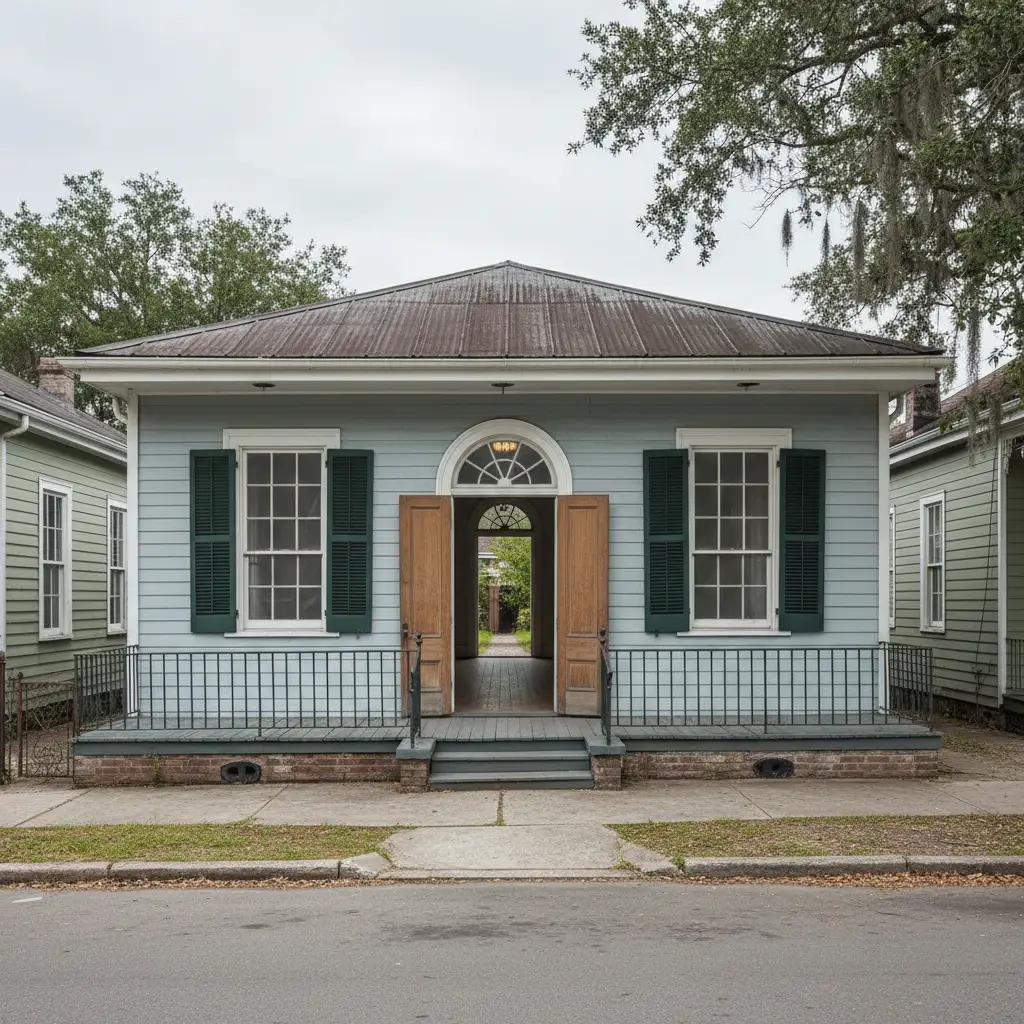
What Is a Shotgun House?
A shotgun house is a distinctive architectural style characterized by its long, narrow form and linear room arrangement. Typically, these homes measure about 12 to 15 feet wide and extend 60 to 100 feet deep, with rooms arranged in a single file from front to back.
Unlike conventional homes, a shotgun house features no hallways. Instead, each room opens directly into the next, creating a straight path through the entire dwelling. The front and rear doors often align perfectly, which not only defines the floor plan but also contributes to the home’s iconic name.
This architectural form became widespread across the American South, particularly in New Orleans and other Gulf Coast cities, where it served as affordable, practical housing from the mid-1800s through the early 20th century.
Key Features and Typical Layout
Common Dimensions, Room Sequence, and "No Hallway" Plan
The classic shotgun house layout follows a predictable pattern. Most shotgun houses sit on narrow urban lots, with their gable ends facing the street. The typical sequence begins with a front porch, followed by a living room, one or two bedrooms, and a kitchen at the rear.
Because there are no hallways, residents must walk through each room to reach the next. This design maximized usable square footage on small, affordable lots—a practical solution for working-class families and a response to per-foot frontage taxes in some cities.
Room dimensions remain consistent throughout the structure, usually around 12 feet wide. The shotgun house floor plan prioritizes efficiency and simplicity, though it sacrifices some privacy in favor of space and economy.
Ventilation and Climate Design (Aligned Doors, High Ceilings, Transoms)
Beyond its distinctive layout, the shotgun house excels in passive cooling—a crucial feature in the hot, humid Southern climate. The alignment of front and back doors creates a natural breezeway, allowing cross-ventilation to flow through the entire home when doors are opened.
High ceilings, often 10 to 12 feet, help hot air rise away from living spaces. Many shotgun houses also feature transom windows above interior doorways, which facilitate airflow even when doors are closed for privacy.
Raised foundations lift the home off the ground, promoting air circulation beneath the floor and protecting against flooding. Together, these design elements made the shotgun house remarkably well-suited to pre-air-conditioning life in the South.
Origins, Geography, and the Name "Shotgun"
The shotgun house emerged in the Southern United States during the early to mid-19th century, with the highest concentration in New Orleans, Louisiana. From there, the style spread along the Mississippi River and throughout the Gulf Coast region, as well as to cities like Houston, Mobile, and Memphis.
The architectural roots likely trace back to Haitian immigrants who arrived in New Orleans in the early 1800s. These building traditions, in turn, may have originated in West Africa, where similar narrow, room-by-room dwellings existed.
Geography played a key role in the shotgun house’s popularity. Narrow city lots, humid climates, and economic constraints all favored this efficient, ventilated design. The style became embedded in Southern working-class neighborhoods and remains an enduring symbol of regional vernacular architecture.
Etymology: The "Shotgun Blast" Story vs Language-Origin Theories
The most popular explanation for the term "shotgun house" suggests that if you fired a shotgun through the front door, the blast would travel straight through all the aligned doorways and exit the back without hitting a wall.
However, folklorists and architectural historians offer an alternative theory. The name may derive from the West African term "shogun" or "to-gun," meaning "place of assembly" or "house" in Yoruba and related languages. This linguistic connection aligns with the architectural lineage linking the shotgun house to Caribbean and African building traditions.
While the shotgun blast story remains widely repeated, the language-origin theory provides a compelling cultural and historical explanation that connects the home’s form to its roots.
Types of Shotgun Houses
Double-Barrel, Camelback, and Modified/Modernized Variations
The basic shotgun house spawned several variations to meet different needs. A double-barrel shotgun house consists of two parallel shotgun units sharing a common central wall, essentially creating a side-by-side duplex. Each unit maintains the classic narrow, linear layout, and the structure typically features symmetrical facades.
The camelback shotgun house adds a partial second story to the rear portion of the home. This addition provides extra bedrooms or living space while preserving the single-story appearance from the street—an important consideration in neighborhoods with height restrictions or aesthetic norms.
Modern adaptations of the shotgun house address contemporary living needs. Renovated versions often reconfigure interior walls to add hallways, insert modern bathrooms and closets, and introduce open-concept elements. Some new construction borrows the shotgun footprint while updating materials, fenestration, and interior flow to balance historic charm with modern functionality.
Living in (or Renovating) a Shotgun House Today
Today, shotgun houses occupy an interesting place in the housing market. In cities like New Orleans, they represent both affordable housing stock and desirable historic properties, depending on location and condition.
Living in an original shotgun house presents unique challenges. The lack of hallways and privacy, limited storage, and often-outdated plumbing and electrical systems require adjustment or investment. Middle rooms can feel dark, and installing central heating and air conditioning often demands creative solutions.
Nevertheless, many homeowners embrace shotgun house renovations. Thoughtful updates can preserve the home’s character while improving livability. Common improvements include adding bathrooms, installing skylights or interior windows to brighten inner rooms, creating partial hallways or flexible circulation paths, and upgrading insulation and mechanical systems.
The narrow footprint and efficient use of space also appeal to sustainability-minded buyers and those drawn to walkable urban neighborhoods. When renovated with care, a shotgun house can offer distinctive, functional living space that honors its vernacular roots while meeting modern expectations.