Apartment Rents Declined for the Second Year in a Row
By
Raissa Cunha
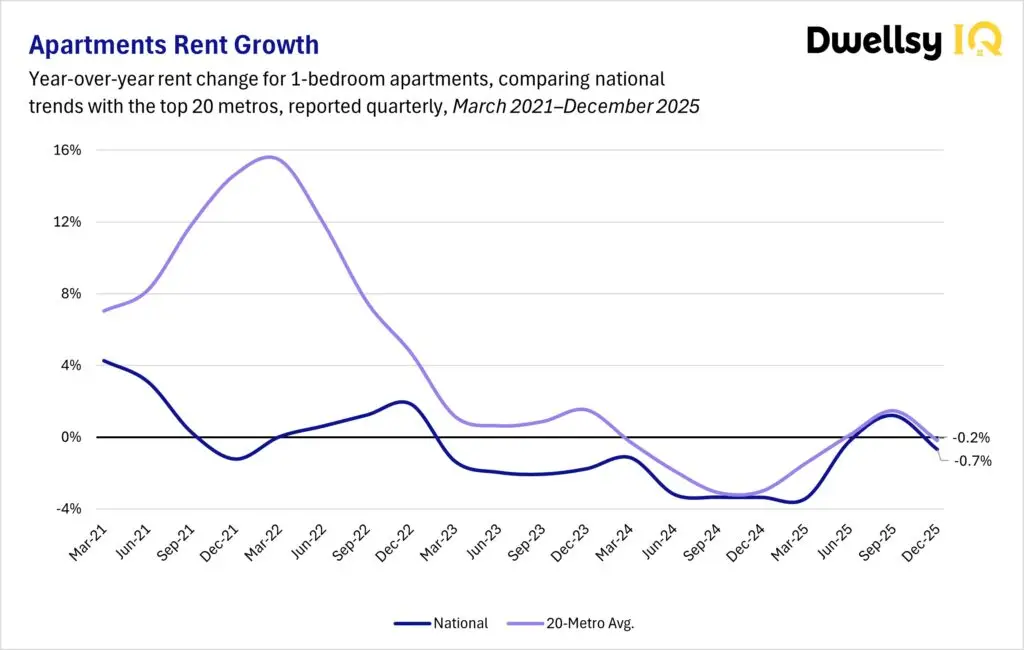
Did U.S. apartment rents fall? The 2026 Rental Housing Index by Dwellsy IQ shows apartment rents declined 0.7% to $1,338, marking a second straight year of decreases as supply pressures and affordability constraints reshaped the rental market.
The 2026 Rental Housing Index, released by Dwellsy IQ, shows that U.S. apartment rents declined for the second consecutive year in 2025. Rents for one-bedroom units fell by 0.7% ($9) year over year, finishing at $1,338 per month. The report, published in 2026, analyzes full-year 2025 rental housing data, offering a backward-looking view of how the apartment sector adjusted following the extreme volatility of the early 2020s.
The analysis is based on Dwellsy IQ rental data and was conducted by Jonas Bordo, CEO and cofounder of Dwellsy, together with Paul Briggs of Briggs Advisors, combining decades of experience in rental housing data, research, and market analysis.
Download the 2026 Rental Market Report
This article covers only part of the trends observed, as analyzed in the 2026 Rental Housing Index. Download the full report, reviewing rental market performance, for complete national and metro-level analysis across U.S. apartment markets.
Apartment performance in 2025 continued the downward adjustment that began in 2024. National rents declined by 0.7% ($9) during 2025, following a steeper 3.4% ($47) drop the previous year.
At the end of 2025, national apartment rents averaged $1,338 per month. That level sits below where rents stood at the start of 2020 ($1,381) and well below the summer 2022 peak of more than $1,460. Much of the decline occurred after that 2022 high point, as supply expanded and market conditions normalized.
Over the past five years, apartment rent performance has been materially flatter than single-family rental trends on a national basis. While seasonal increases and decreases continued, the broader trajectory since mid-2022 has been downward rather than growth-driven.
Unlike houses, which faced more limited supply pressure, the apartment sector absorbed a significant wave of post-pandemic construction deliveries. That additional inventory placed sustained downward pressure on rents across many major metropolitan areas.
Why Did Apartment Rents Decline?
Apartment rents declined primarily due to elevated new supply in many major markets. Large volumes of post-pandemic deliveries increased vacancy pressure, limiting landlords’ ability to push rents higher.
Affordability constraints also played a central role. Although household incomes have risen, higher overall living costs and the cumulative impact of earlier rent increases strained household budgets. This environment reduced tenants’ capacity to absorb additional rent growth, particularly in markets already dealing with elevated vacancy levels.
While decreasing construction activity is beginning to have a positive effect in certain metros, the lag between development starts and completions meant supply pressure continued to weigh on apartment fundamentals through 2025.
The result was a second consecutive year of modest national rent contraction, signaling adjustment rather than systemic weakness.
How Did Apartment Rent Trends Vary by Market?
Although national apartment rents declined, metro-level outcomes varied.
Among the top 20 metropolitan areas analyzed, four markets posted positive rent growth of 4% to 6% in 2025: Detroit, Chicago, Minneapolis, and Atlanta. New York recorded the fifth-strongest growth among major markets. Notably, all five of these markets had experienced negative rent growth in 2024, representing a meaningful transition back to positive momentum.
Conversely, several markets recorded substantial declines. Six major metros posted negative rent growth in the 3% to 4% range during 2025. Denver experienced the sharpest drop, with rents falling by nearly 7%. Houston stood out as the only major market to underperform the national average in both 2024 and 2025, reflecting persistent local challenges.
These differences underscore how national averages can obscure local dynamics. Rent performance in each metro depends on the interaction between supply pipelines, economic growth, cost-of-living pressures, and household demand.
Download the 2026 Rental Market Report
This article covers only part of the trends observed, as analyzed in the 2026 Rental Housing Index. Download the full report, reviewing rental market performance, for complete national and metro-level analysis across U.S. apartment markets.
The 2026 Rental Housing Index is a data-driven report released by Dwellsy IQ that analyzes rental price movements across the United States. Published in 2026, it examines full-year 2025 rental housing data to provide a backward-looking assessment of market conditions following the volatility of the early 2020s.
What does the 2026 Rental Housing Index show about apartment rents?
The index shows that U.S. apartment rents declined for the second consecutive year. National rents fell by 0.7% in 2025, following a 3.4% decline in 2024, ending the year at an average of $1,338 per month.
Why did apartment rents decline for two consecutive years?
Apartment rents declined primarily due to elevated new supply in many markets and affordability constraints that limited tenants’ ability to absorb further rent increases. Post-pandemic construction deliveries increased vacancy pressure, while higher living costs constrained rent growth.
How do current apartment rents compare to recent peaks?
Apartment rents peaked in the summer of 2022 at more than $1,460. By the end of 2025, average rents had fallen to $1,338, placing them below both the 2022 peak and the level recorded at the beginning of 2020.
Did apartment rent performance vary by city?
Yes. Some markets, including Detroit, Chicago, Minneapolis, Atlanta, and New York, recorded positive rent growth in 2025. Others, such as Denver and Houston, experienced continued declines. Local supply conditions, economic growth, and cost-of-living factors drove these differences.
Why do national apartment rent averages not reflect local conditions?
National averages provide a broad directional view but mask metro-level variation. Individual cities experience different supply pipelines, vacancy levels, and economic conditions, which significantly influence local rent performance.
About the Author
Raissa Cunha
Raíssa has been leading marketing at Dwellsy since early 2025, bringing five years of experience in content, strategy, and storytelling. She began honing her skills in 2016 with an Associate Degree in Marketing, later earning a Bachelor's in Communication and Marketing. A lifelong reader, she loves challenges, a good sense of humor, and when people don’t talk about themselves in the third person… like she just did.