What Is a Micro Unit?
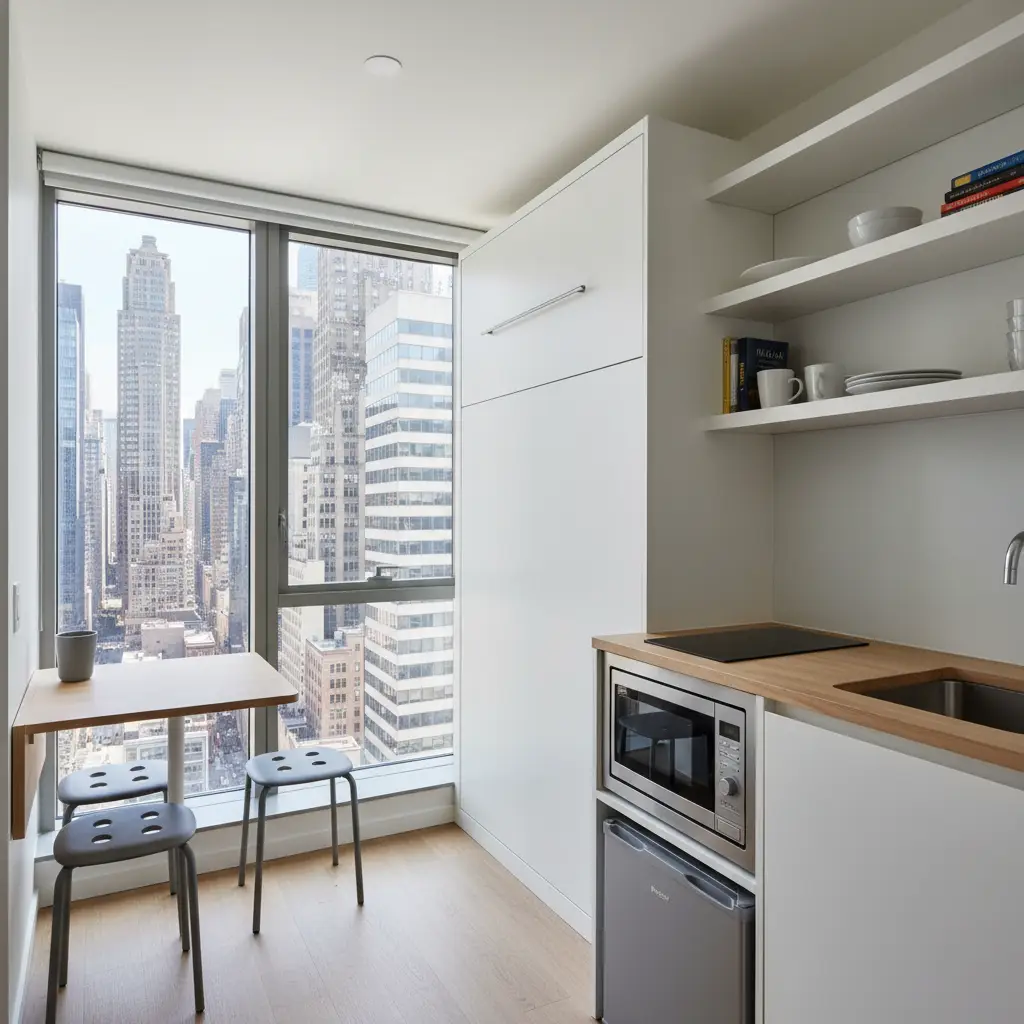
Micro units are self-contained apartments — typically under 400 square feet — designed to pack full residential functionality into a compact footprint.
Most include a private bathroom, a sleeping area, and a small but complete kitchen or kitchenette. The defining characteristic is intentional space efficiency: every square foot is planned to serve a purpose, often through built-in storage, fold-down furniture, or convertible layouts.
Unlike a room in a shared apartment, a micro unit is a fully independent dwelling. Residents have their own front door, their own kitchen, and their own bath — the unit simply fits all of that into significantly less space than a conventional apartment.
Micro Units vs. Studios and Efficiency Apartments
The line between micro units and studios can blur, but the distinctions matter for renters, investors, and developers evaluating unit mix.
A traditional studio typically runs between 400 and 600 square feet. An efficiency apartment sits in a similar range and often skips a full kitchen in favor of a kitchenette. Micro units, by contrast, are generally sub-400 square feet — and in many urban markets, they range from 150 to 350 square feet.
In terms of layout, micro units are more deliberately engineered. Designers typically integrate Murphy beds, built-in cabinetry, and modular furniture from the ground up, rather than simply downsizing a standard floor plan.
On rent, micro units often carry a lower absolute monthly cost than studios in the same building or submarket. However, rent per square foot is frequently higher. A 250-square-foot micro unit priced at $1,800/month runs $7.20/sq ft — well above the $3–$4/sq ft more common in larger units in many markets.
Why Micro Units Are Growing in High-Cost Markets
Micro units have gained traction precisely where housing pressure is most acute: dense, supply-constrained cities like New York, San Francisco, Seattle, Boston, and Washington, D.C.
Several structural forces are driving this growth. First, affordability. In markets where a one-bedroom averages $2,500–$3,500/month, a micro unit at $1,500–$1,800/month represents a lower absolute rent, even if the price per square foot is higher.
Second, zoning and land economics. In high-land-cost environments, developers face pressure to maximize revenue per buildable square foot. Micro units allow more doors per floor, which can improve gross rent potential on a per-building basis — depending on local zoning, minimum unit size requirements, and parking rules.
Third, shifting household demographics. Single-person households are growing as a share of total U.S. households. Renters who live alone and spend significant time outside the home — commuting, working remotely from cafes, or traveling — often place less value on raw square footage and more value on location and access to transit and amenities.
Finally, housing shortages in gateway cities have made any attainable option more competitive. In markets where vacancy rates sit below 4%, smaller units that would have struggled to lease a decade ago now fill quickly.
Pros, Cons, and Who Micro Units Fit Best
For renters, the primary draw is lower total monthly cost in high-demand locations. A renter who cannot afford a studio near a job center may be able to afford a micro unit in the same neighborhood.
That said, the tradeoffs are real. Limited storage, no separation between sleeping and living space, restricted capacity for guests, and the psychological weight of a small environment are consistent challenges renters report. Micro units work best for individuals who spend limited time at home and have access to building amenities — coworking lounges, rooftop decks, fitness centers — that extend their functional living space beyond the unit walls.
For investors and developers, micro units introduce a specific performance profile. More units per floor can increase total rental income on a given footprint. Turnover may be higher, as residents often move up in size as their income or household grows. Operating costs per unit — leasing, maintenance, and administrative overhead — do not scale down proportionally with unit size, which can compress net operating income margins relative to larger unit types.
Micro unit performance also depends heavily on submarket conditions. In dense, transit-rich neighborhoods with strong single-renter demand, vacancy rates and achievable rents tend to hold. In secondary locations without those characteristics, smaller units can face more resistance.
How to Evaluate a Micro Unit Before Renting, Buying, or Developing
Whether evaluating a micro unit as a renter, an investor acquiring an existing asset, or a developer planning a new project, the same core variables apply.
Layout efficiency is the starting point. The floor plan should eliminate dead space. A poorly designed micro unit can feel unusable despite its square footage; a well-designed one can feel functional and livable. Look for ceiling height, window placement, and whether the design integrates storage and furniture intelligently.
Building amenities matter more in a micro unit context than in a standard apartment. Because the unit itself offers limited space for work, social gatherings, or storage, buildings that provide common areas, package rooms, bike storage, and shared workspaces compensate for those limitations.
Storage deserves its own evaluation. Built-in closets, under-bed storage, and vertical shelving are not bonuses — they are requirements for a livable micro unit. Projects that overlook storage tend to generate tenant dissatisfaction and higher turnover.
Neighborhood economics and transit access are perhaps the most critical factors. Micro units derive most of their value proposition from location. A micro unit that removes the need for a car, shortens the commute, or places a renter near employment centers justifies the premium rent per square foot. One that does not is harder to defend.
Regulatory constraints are essential due diligence for developers and investors. Many cities impose minimum unit size requirements, minimum parking ratios, or owner-occupancy restrictions that directly affect whether a micro unit project is feasible or legal. Some jurisdictions have created carve-outs or pilot programs specifically for micro units — understanding local zoning before underwriting is non-negotiable.
FAQ
What is a micro unit in real estate?
A micro unit is a self-contained apartment, typically under 400 square feet, designed to maximize functionality in a small footprint. Most include a private bathroom, compact kitchen, and multipurpose living space.
Are micro units cheaper than studios?
They are often cheaper in total monthly rent than larger studios or one-bedrooms, but they can carry a higher rent per square foot. For investors and renters, the value usually depends on location, amenities, and demand in the submarket.
Who are micro units best for?
Micro units tend to fit singles, students, young professionals, and urban renters who prioritize location, transit access, and lower overall housing costs over extra space.
Do micro units make sense as an investment or development strategy?
They can, especially in dense, high-cost markets where affordability pressure is strong and renter demand favors smaller layouts. Investors and developers should still evaluate zoning rules, parking requirements, unit mix, operating costs, and achievable rent per square foot.