{“markdown”:”
What Is a Perpetuity?
\n
A perpetuity is a financial instrument that pays a fixed — or steadily growing — cash flow at regular intervals with no end date. Unlike a bond or a lease, there is no maturity and no final payment.
\n
Common real-world examples include preferred stock dividends, certain government bonds, and stabilized real estate income modeled over an indefinite holding horizon.
\n
Why an Infinite Cash Flow Stream Can Still Have a Finite Present Value
\n
Infinite payments do not imply infinite value. The reason is discounting.
\n
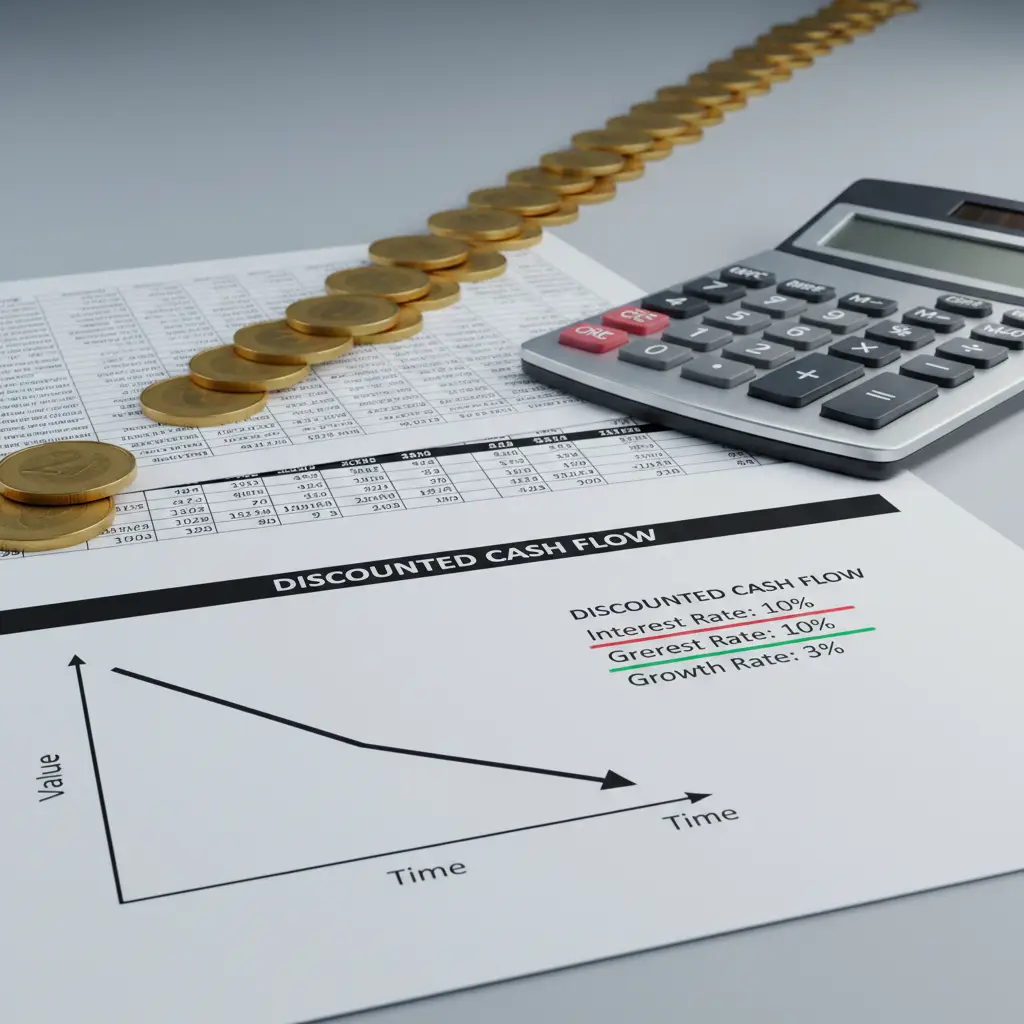
Each future cash flow is worth less in today’s dollars than the one before it. As payments stretch further into the future, their present value contribution shrinks toward zero. The sum of all those discounted payments converges to a finite number — and that is precisely what the perpetuity formula calculates.
\n
Perpetuity Formula and Growing Perpetuity Formula
\n
Two versions of the perpetuity formula apply depending on whether cash flows are constant or growing.
\n
The constant perpetuity formula assumes the same payment repeats forever:
\n
PV = C / r
\n
The growing perpetuity formula accounts for cash flows that increase at a steady rate each period:
\n
PV = C / (r ? g)
\n
Variables, Assumptions, and When to Use Next-Period Cash Flow
\n
Here is what each variable represents:
\n
- \n
- PV — Present value of the perpetuity
- C — Cash flow received at the end of the first period (next-period cash flow)
- r — Discount rate, or required rate of return
- g — Constant growth rate (growing perpetuity only)
\n
\n
\n
\n
\n
Both formulas use next-period cash flow, not the current or most recent payment. If you have a current cash flow of C? growing at rate g, the correct input is C? × (1 + g).
\n
Additionally, the growing perpetuity formula only produces a valid result when r > g. If growth equals or exceeds the discount rate, the denominator becomes zero or negative, and the formula does not hold.
\n
How to Calculate Perpetuity Value Step by Step
\n
Applying the perpetuity formula requires identifying three inputs: the next-period cash flow, the discount rate, and — for a growing perpetuity — the growth rate.
\n
Follow these steps:
\n
- \n
- Identify next-period cash flow (C)
- Determine the appropriate discount rate (r)
- For a growing perpetuity, determine the constant growth rate (g) and confirm r > g
- Apply either PV = C / r or PV = C / (r ? g)
\n
\n
\n
\n
\n
Worked Example: Constant Perpetuity vs Growing Perpetuity
\n
Constant perpetuity:
An investment pays $5,000 per year forever. The discount rate is 8%.
\n
PV = $5,000 / 0.08 = $62,500
\n
Growing perpetuity:
The same investment pays $5,000 next year, but cash flows grow at 3% per year. The discount rate remains 8%.
\n
PV = $5,000 / (0.08 ? 0.03) = $5,000 / 0.05 = $100,000
\n
The difference between the two results — $62,500 versus $100,000 — illustrates how sensitive perpetuity valuations are to the growth rate assumption.
\n
Where the Perpetuity Formula Is Used in Investing and Real Estate
\n
The perpetuity formula applies wherever long-duration or indefinite cash flow streams need to be converted into a single present value figure. Across investing and real estate, several contexts rely on it directly.
\n
DCF Terminal Value, Dividend Models, Preferred Stock, and Stabilized Property Income
\n
DCF terminal value: In a discounted cash flow model, the terminal value captures all cash flows beyond the explicit forecast period. The Gordon Growth Model — a direct application of the growing perpetuity formula — is one of the most widely used methods for this calculation.
\n
Dividend discount models: For stocks expected to pay dividends indefinitely, analysts use the growing perpetuity formula to estimate intrinsic value. Inputs include the next expected dividend, the required return on equity, and the assumed long-term dividend growth rate.
\n
Preferred stock: Preferred shares typically pay a fixed dividend with no maturity date. Because payments are constant and perpetual, the constant perpetuity formula applies directly: PV = Dividend / r.
\n
Stabilized real estate income: In real estate valuation, a stabilized property’s net operating income (NOI) is often treated as a perpetuity. The capitalization rate used in real estate is the direct equivalent of r, making the familiar formula Value = NOI / Cap Rate a straightforward application of the perpetuity formula.
\n
Perpetuity vs Annuity: Key Differences for Valuation
\n
An annuity delivers cash flows for a defined number of periods. A perpetuity delivers cash flows with no end date. That distinction shapes how each tool is applied in financial analysis.
\n
Annuities require knowing the number of periods, which makes them well-suited for mortgages, bond coupon streams, and fixed-term lease payments. The perpetuity formula, by contrast, requires no period count — only a cash flow, a rate, and optionally a growth rate.
\n
Furthermore, as the number of periods in an annuity increases toward infinity, its present value approaches the present value of a comparable perpetuity. This makes the perpetuity a useful upper-bound reference or simplifying assumption for long-duration cash flow analysis.
\n
FAQ
\n
What is the perpetuity formula?
\n
The constant perpetuity formula is PV = C / r, where C is the periodic cash flow and r is the discount rate.
\n
What is the growing perpetuity formula?
\n
The growing perpetuity formula is PV = C / (r ? g), where C is next period’s cash flow, r is the discount rate, and g is the constant growth rate.
\n
Why does a perpetuity have a finite present value if payments last forever?
\n
Because each future cash flow is discounted back to today. Over time, distant payments contribute less to present value, so the total converges to a finite amount.
\n
When do investors use a perpetuity formula in real estate and valuation?
\n
Investors use it for DCF terminal value, dividend discount models, preferred stock valuation, perpetual bonds, and stabilized real estate income assumptions.
\n
What condition must hold for a growing perpetuity?
\n
The discount rate must be greater than the growth rate: r > g. If growth is equal to or higher than the discount rate, the formula does not produce a valid finite value.
\n
What is the difference between an annuity and a perpetuity?
\n
An annuity has a fixed number of payments, while a perpetuity continues indefinitely. That makes perpetuity a useful shortcut for valuing long-duration cash-flow streams.
“}