Trying to figure out where apartment rents are actually rising? It largely comes down to geography. Despite national apartment rent movement staying negative in 2025, nine of the top 20 markets recorded rent growth — Atlanta in particular stood out — highlighting once again that rental momentum is shaped locally, not nationally.
This exclusive look at apartment rent trends is powered by Dwellsy IQ data for one-bedroom apartments at both the national level and across the top 20 U.S. MSAs. The findings come from the 2026 Rental Housing Index, produced using Dwellsy’s first-party rental dataset and analysis conducted by Jonas Bordo, CEO and cofounder of Dwellsy, together with Paul Briggs of Briggs Advisors.
Download the 2026 Rental Market Report
This article covers only part of the trends observed, as analyzed in the 2026 Rental Housing Index. Download the full report, reviewing rental market performance, for complete national and metro-level analysis across U.S. apartment markets.
Cities Where Apartment Rents Are Rising the Fastest
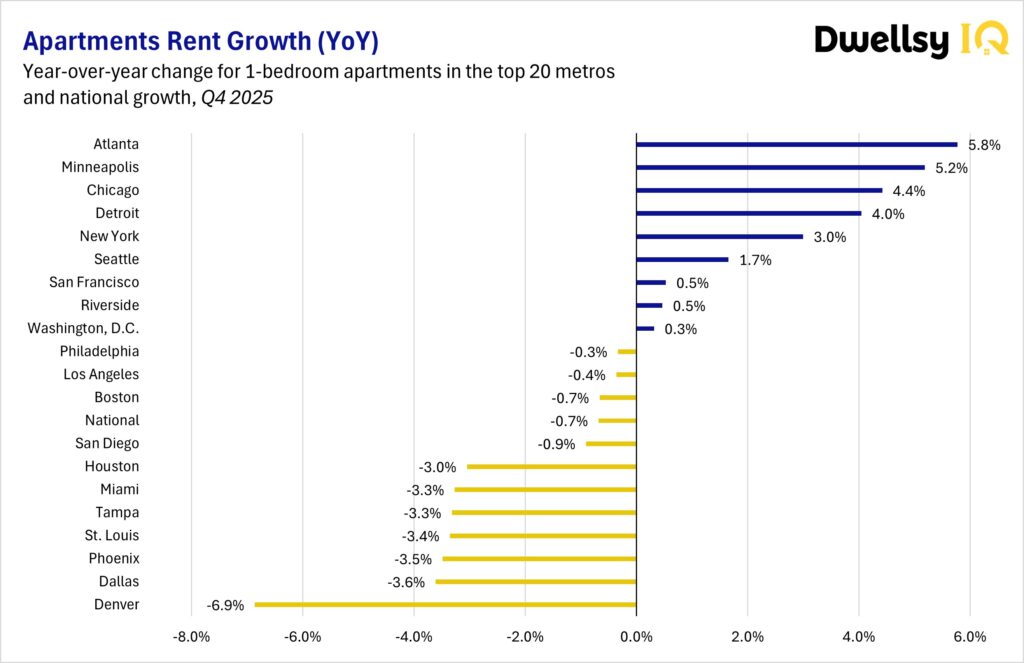
Year-over-year data for one-bedroom apartments across the top 20 metros shows that nine cities saw rent growth. However, trends were far from uniform — the list below ranks markets from the highest to the lowest pace of positive change.
1. Atlanta — +5.8%
Atlanta recorded the strongest apartment rent increase among major U.S. metros. Average one-bedroom rents increased from $1,350 to $1,428, representing a sharp reversal from 2024’s decline and marking the fastest growth rate nationally.
2. Minneapolis — +5.2%
Minneapolis posted the second-fastest growth rate, with rents rising from $1,157 to $1,217. After contracting in 2024, the market rebounded strongly in 2025, placing it firmly among the top-performing apartment markets.
3. Chicago — +4.4%
Chicago continued its momentum across rental sectors, with apartment rents increasing from $1,539 to $1,607. The city ranked third among major metros, reinforcing its position as one of the most resilient rental markets in 2025.
4. Detroit — +4.0%
Detroit recorded solid growth, with rents rising from $1,016 to $1,057. Following one of the sharpest declines in 2024, Detroit’s rebound placed it fourth nationally in apartment rent growth.
5. New York — +3.0%
New York posted the fifth-fastest increase, with rents rising from $3,143 to $3,237. In a high-cost housing market, this growth signals renewed upward pressure after a steep correction in the prior year.
6. Seattle — +1.7%
Seattle experienced moderate positive growth, with rents increasing from $1,752 to $1,781. The market remained above national performance but well below the top-tier growth rates seen in Atlanta and Minneapolis.
7. San Francisco — +0.5%
San Francisco posted limited but positive growth, with rents rising from $2,442 to $2,455, reflecting largely stable conditions in one of the country’s highest-cost apartment markets.
8. Riverside–San Bernardino — +0.5%
Riverside recorded modest growth, with rents increasing from $1,906 to $1,915. The metro saw stabilization rather than acceleration, remaining slightly above the national average.
9. Washington, D.C.— +0.3%
Washington, D.C. posted minimal but positive growth, with rents rising from $2,009 to $2,015, effectively tracking close to flat conditions while still outperforming the national trend.
How much faster did these cities grow compared to the national average?
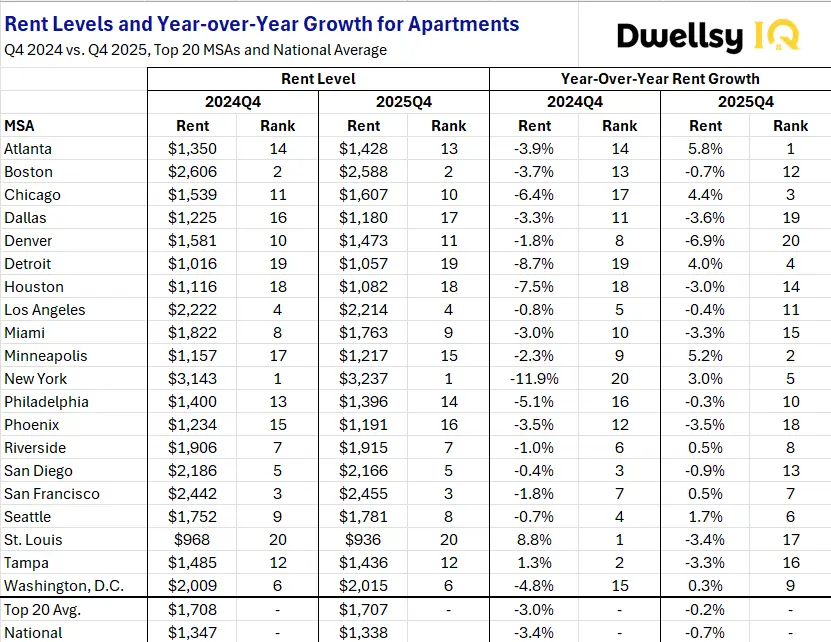
At the national level, apartment rents declined by 0.7%, falling from $1,347 to $1,338. This marked the second consecutive year of national contraction, raising a broader question for investors and housing analysts: will apartment rents rise in 2026?
Against this backdrop:
- Atlanta’s 5.8% growth was more than eight times the magnitude of the national decline.
- Minneapolis grew 5.2%, outperforming the broader U.S. market.
- Chicago (+4.4%) and Detroit (+4.0%) also posted strong rebounds relative to national contraction.
- New York’s 3.0% increase represented a clear divergence from the nationwide trend.
A second group of markets — including Seattle (+1.7%), San Francisco (+0.5%), Riverside (+0.5%), and Washington, D.C. (+0.3%) — recorded modest gains while the nation declined.
Meanwhile, several markets posted significant rent declines, such as Denver and Dallas, highlighting how elevated new supply and affordability constraints continue to weigh on rent performance in certain regions.
Download the 2026 Rental Market Report
This article covers only part of the trends observed, as analyzed in the 2026 Rental Housing Index. Download the full report, reviewing rental market performance, for complete national and metro-level analysis across U.S. apartment markets.
FAQ
Which U.S. cities have the fastest rising apartment rents right now?
According to the 2026 Rental Housing Index released by Dwellsy IQ, Atlanta recorded the fastest apartment rent growth at 5.8%, followed by Minneapolis (5.2%), Chicago (4.4%), Detroit (4.0%), and New York (3.0%).
Are apartment rents increasing nationally in the U.S.?
No. Nationally, apartment rents declined by 0.7% in 2025.
What is the national average apartment rent?
The national average rent for an apartment was $1,338 in the last quarter of 2025.
What is the average apartment rent in Atlanta?
The average apartment rent in Atlanta is $1,428.
What is the average apartment rent in Minneapolis?
The average apartment rent in Minneapolis is $1,217.
What is the average apartment rent in Chicago?
The average apartment rent in Chicago is $1,607.
What is the average apartment rent in Detroit?
The average apartment rent in Detroit is $1,057.
What is the average apartment rent in New York?
The average apartment rent in New York is $3,237.
What is the average apartment rent in San Francisco?
The average apartment rent in San Francisco is $2,455, based on the most recent data available in the 2026 Rental Housing Index by Dwellsy IQ.
What is the average apartment rent in Riverside–San Bernardino?
The average apartment rent in Riverside–San Bernardino is $1,915, based on the most recent data available in the 2026 Rental Housing Index by Dwellsy IQ.
What is the average apartment rent in Washington, D.C.?
The average apartment rent in Washington, D.C. is $2,015, based on the most recent data available in the 2026 Rental Housing Index by Dwellsy IQ.