If you’ve been trying to understand where house rents are still increasing, the answer depends heavily on location. While national rent movement remained modest, several metropolitan areas recorded stronger gains — with Chicago standing out as the clearest outlier — showing that local dynamics continue to shape rental performance more than nationwide averages.
This exclusive look at house rent trends is powered by Dwellsy IQ data for three-bedroom houses at both the national level and across the top 20 U.S. MSAs. The findings come from the 2026 Rental Housing Index, produced using Dwellsy’s first-party rental dataset and analysis conducted by Jonas Bordo, CEO and cofounder of Dwellsy, together with Paul Briggs of Briggs Advisors.
Download the 2026 Rental Market Report
This article covers only part of the trends observed, as analyzed in the 2026 Rental Housing Index. Download the full report, reviewing rental market performance, for complete national and metro-level analysis across U.S. apartment markets.
Cities Where House Rents Are Rising the Fastest
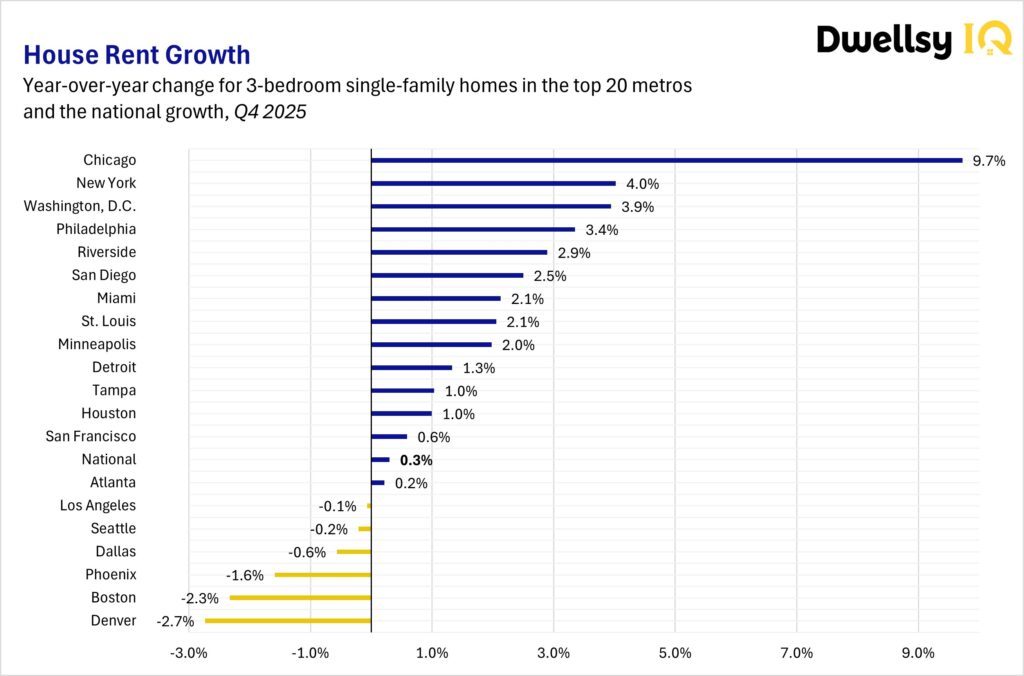
Based on the year-over-year change for three-bedroom houses across the top 20 metropolitan areas, fourteen out of twenty cities experienced growth. Rent performance varied significantly by market; below, the cities are ordered from fastest to slowest positive growth.
1. Chicago — +9.7%
Chicago recorded the strongest increase among major U.S. metros, standing well above all other markets analyzed. Average house rents increased from $2,048 to $2,247, making the city a clear outlier with rent growth approaching double digits and significantly exceeding broader market movement.
2. New York — +4.0%
New York recorded the second-fastest increase in house rents, reflecting continued demand pressure in a high-cost housing market. Average rents increased from $3,214 to $3,343, reinforcing the city’s position among the strongest-performing major metros.
3. Washington, D.C. — +3.9%
Washington, D.C. followed closely behind New York, with house rents rising at nearly the same pace. Average rents increased from $2,753 to $2,862, indicating sustained demand relative to national trends.
4. Philadelphia — +3.4%
Philadelphia posted solid house rent growth, placing it among the fastest-growing large metropolitan areas. Average rents increased from $1,826 to $1,888, reflecting stronger local momentum compared to the broader U.S. market.
5. Riverside–San Bernardino — +2.9%
Riverside recorded strong rent growth compared to national averages, continuing a pattern of demand in more affordable alternative markets. Average rents increased from $2,828 to $2,910, showing steady upward pressure despite overall market stabilization.
6. San Diego — +2.5%
San Diego saw moderate but above-average growth in house rents relative to most major metros. Average rents increased from $3,831 to $3,927, indicating continued strength in higher-cost coastal markets.
7. Miami — +2.1%
Miami experienced continued rent growth supported by sustained demand even as broader market conditions normalized. Average rents increased from $3,160 to $3,227, keeping the metro above the national trend.
8. St. Louis — +2.1%
St. Louis matched Miami’s growth rate, remaining above the national average for house rent increases. Average rents rose from $1,511 to $1,542, reflecting steady but moderate upward movement.
9. Minneapolis — +2.0%
Minneapolis recorded steady rent growth, placing it in the upper half of markets for house rent performance. Average rents increased from $2,216 to $2,260, showing consistent local demand conditions.
10. Detroit — +1.3%
Detroit showed moderate growth, remaining comfortably above the national average. Average rents increased from $1,365 to $1,383, indicating gradual but stable rent expansion.
11. Tampa — +1.0%
Tampa experienced modest house rent growth, indicating stabilization following earlier volatility. Average rents increased from $2,151 to $2,173, suggesting slower but still positive movement.
12. Houston — +1.0%
Houston also recorded modest growth, slightly outperforming national trends. Average rents increased from $1,795 to $1,813, reflecting relatively balanced market conditions.
13. San Francisco — +0.6%
San Francisco posted limited but positive growth, remaining above the national average. Average rents increased from $3,758 to $3,780, indicating largely stable rent conditions.
14. Atlanta — +0.2%
Atlanta recorded minimal growth, effectively tracking close to flat rent movement. Average rents increased slightly from $1,837 to $1,841, showing near-stable pricing despite stronger growth in many other metros.
How much faster did these cities grow compared to the national average?
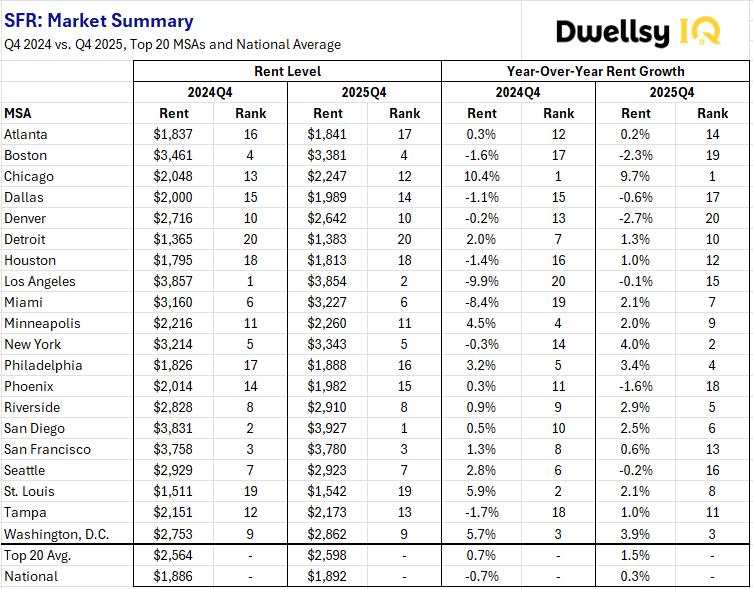
At the national level, house rents increased by 0.3%, rising from $1,886 to $1,892, reflecting a market that had largely stabilized after the sharp increases earlier in the decade, raising an important question for investors and housing analysts: will house rents rise again in 2026?
On the other hand, compared with this modest nationwide movement, several metropolitan areas recorded substantially stronger increases.
Chicago stood far above the national trend, with house rents rising 9.7%, increasing from $2,048 to $2,247 — more than 30 times the national increase. This made Chicago a clear outlier among major U.S. markets, with growth levels that significantly exceeded broader market movement.
New York (4.0%) and Washington, D.C. (3.9%) recorded rent growth more than 13 times the national average, with rents rising from $3,214 to $3,343 in New York and from $2,753 to $2,862 in Washington, D.C. Philadelphia (3.4%) grew at more than 11 times the national rate, with rents increasing from $1,826 to $1,888. These markets demonstrated significantly stronger local demand relative to overall U.S. conditions.
A second group of markets — including Riverside (2.9%), San Diego (2.5%), Miami (2.1%), St. Louis (2.1%), and Minneapolis (2.0%) — recorded increases between 7 and 10 times higher than the national average. Rents increased from $2,828 to $2,910 in Riverside, from $3,831 to $3,927 in San Diego, from $3,160 to $3,227 in Miami, from $1,511 to $1,542 in St. Louis, and from $2,216 to $2,260 in Minneapolis, indicating steady upward pressure on rents even as national growth slowed.
Meanwhile, Detroit (1.3%), Tampa (1.0%), Houston (1.0%), and San Francisco (0.6%) posted gains between two and four times the national increase. Detroit rents rose from $1,365 to $1,383, Tampa from $2,151 to $2,173, Houston from $1,795 to $1,813, and San Francisco from $3,758 to $3,780. Atlanta, by contrast, rose just 0.2%, with rents moving from $1,837 to $1,841, which is roughly two-thirds of the national rate, showing near-flat conditions despite stronger growth in many other metros.
Download the 2026 Rental Market Report
This article covers only part of the trends observed, as analyzed in the 2026 Rental Housing Index. Download the full report, reviewing rental market performance, for complete national and metro-level analysis across U.S. apartment markets.
FAQ
Which U.S. cities have the fastest rising house rents right now?
According to the 2026 Rental Housing Index released by Dwellsy IQ, Chicago recorded the fastest house rent growth among major U.S. metropolitan areas, with rents increasing by 9.7%. Other cities with strong rent growth included New York, Washington, D.C., and Philadelphia.
Are house rents increasing nationally in the U.S.?
Nationally, house rents increased modestly by 0.3%, indicating that overall rent movement has stabilized even as some individual cities continue to experience stronger growth.
Why are house rents rising faster in some cities than others?
House rent performance varies by metro due to differences in local housing supply, affordability conditions, economic growth, and demand for rental housing. Cities with tighter supply or stronger demand tend to see faster rent increases than the national average.
Are house rents rising everywhere in the U.S.?
No. While many metropolitan areas recorded rent increases, some markets showed minimal growth or near-flat conditions. Atlanta, for example, grew slightly below the national average, highlighting how local conditions drive rent outcomes.
What is the average house rent in Chicago?
The average house rent in Chicago is $2,247, based on the most recent data available in the 2026 Rental Housing Index by Dwellsy IQ.
What is the average house rent in New York?
The average house rent in New York is $3,343, based on the most recent data available in the 2026 Rental Housing Index by Dwellsy IQ.
What is the average house rent in Washington, D.C.?
The average house rent in Washington, D.C. is $2,862, based on the most recent data available in the 2026 Rental Housing Index by Dwellsy IQ.
What is the average house rent in Philadelphia?
The average house rent in Philadelphia is $1,888, based on the most recent data available in the 2026 Rental Housing Index by Dwellsy IQ.
What is the average house rent in Riverside–San Bernardino?
The average house rent in Riverside–San Bernardino is $2,910, based on the most recent data available in the 2026 Rental Housing Index by Dwellsy IQ.
What is the average house rent in San Diego?
The average house rent in San Diego is $3,927, based on the most recent data available in the 2026 Rental Housing Index by Dwellsy IQ.
What is the average house rent in Miami?
The average house rent in Miami is $3,227, based on the most recent data available in the 2026 Rental Housing Index by Dwellsy IQ.
What is the average house rent in St. Louis?
The average house rent in St. Louis is $1,542, based on the most recent data available in the 2026 Rental Housing Index by Dwellsy IQ.
What is the average house rent in Minneapolis?
The average house rent in Minneapolis is $2,260, based on the most recent data available in the 2026 Rental Housing Index by Dwellsy IQ.
What is the average house rent in Detroit?
The average house rent in Detroit is $1,383, based on the most recent data available in the 2026 Rental Housing Index by Dwellsy IQ.
What is the average house rent in Tampa?
The average house rent in Tampa is $2,173, based on the most recent data available in the 2026 Rental Housing Index by Dwellsy IQ.
What is the average house rent in Houston?
The average house rent in Houston is $1,813, based on the most recent data available in the 2026 Rental Housing Index by Dwellsy IQ.
What is the average house rent in San Francisco?
The average house rent in San Francisco is $3,780, based on the most recent data available in the 2026 Rental Housing Index by Dwellsy IQ.
What is the average house rent in Atlanta?
The average house rent in Atlanta is $1,841, based on the most recent data available in the 2026 Rental Housing Index by Dwellsy IQ.