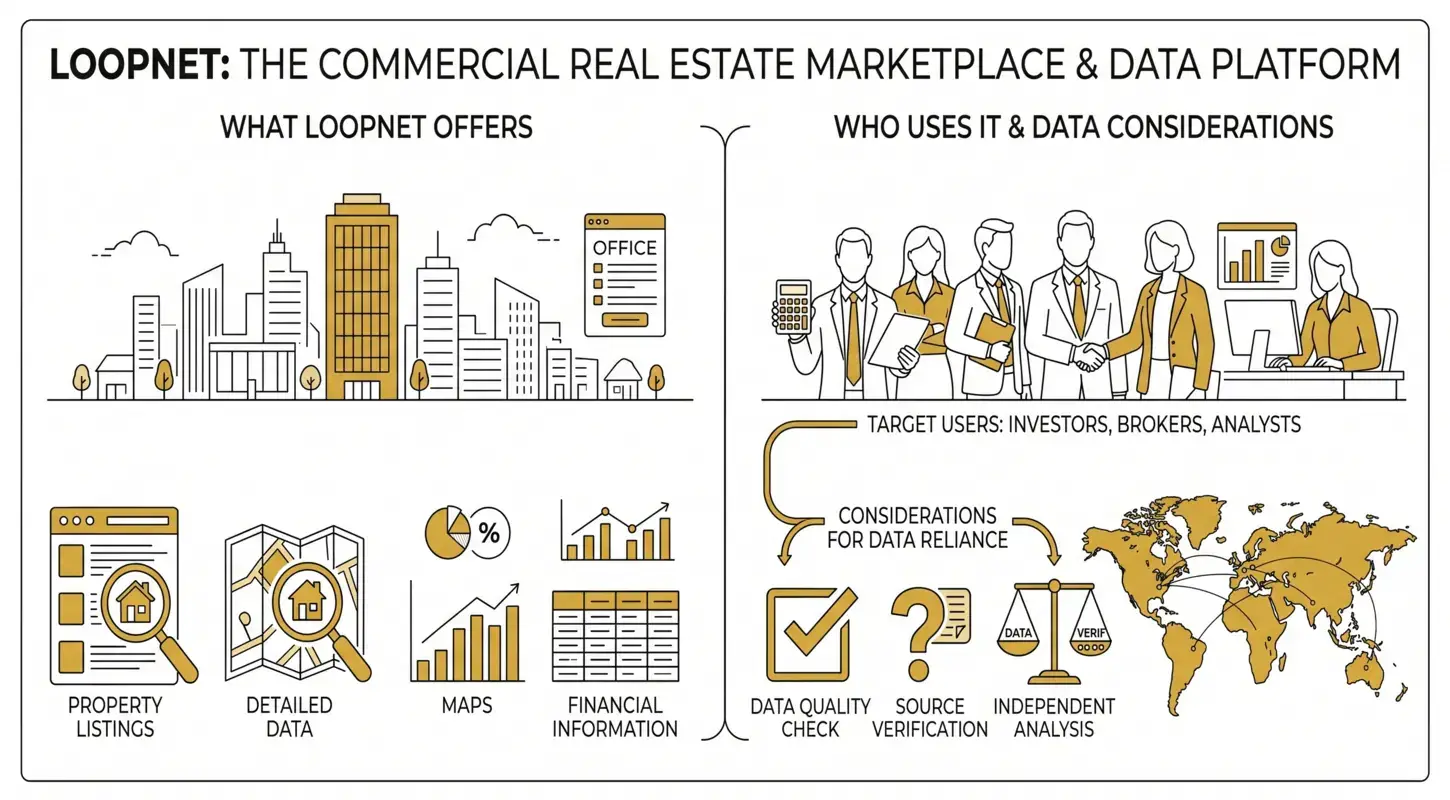
LoopNet is a commercial real estate marketplace focused on the discovery and marketing of properties available for sale and lease. The platform connects brokers, owners, investors, and tenants around CRE inventory. It functions as a listings portal with workflow features built around deal search and diligence.
What Does LoopNet Do?
LoopNet’s core function is listing commercial properties. Brokers, agents, and property owners publish listings on the platform to attract buyers and tenants. On the other side, investors and leasing teams use it to search available inventory and track opportunities.
Beyond basic search, LoopNet provides account-based features designed to support the deal workflow:
- Save and follow individual listings
- Set automated alerts for new matching inventory
- Share listings with teammates for collaborative review
- Access gated confidential documents for early-stage diligence
Additionally, LoopNet offers educational resources framed around CRE investing, suggesting the platform also attracts less experienced market participants — not only seasoned practitioners.
If accurate rental data matters to your decisions, we’re built for you
Dwellsy IQ supports teams across industries who need accuracy, scale, and trust in their rental data.
What Kind of Data Does LoopNet Offer?
LoopNet’s data is rooted in commercial real estate listings — properties for sale or lease. Asset classes represented on the platform include:
- Office
- Retail
- Industrial
- Multifamily (in the commercial sense)
That said, the data is listings-based rather than underwriting-grade. Coverage reflects what brokers and owners choose to market, not a comprehensive property universe. Structured datasets such as ownership records, mortgage data, rent comps, or vacancy rate indices are not part of the core product as publicly documented.
Consequently, LoopNet’s data is more relevant to deal sourcing and market discovery than to quantitative analysis or data infrastructure workflows.
Who Uses LoopNet?
LoopNet serves several distinct user types within the CRE ecosystem:
- Brokers and agents — publishing and marketing listings to attract buyers and tenants
- Investors — searching for acquisition opportunities and tracking available inventory
- Leasing teams — identifying available space and managing early-stage diligence
- Deal teams — collaborating on shared listings in the context of a transaction
Furthermore, the platform’s educational content suggests a segment of users who are newer to commercial real estate investing and using LoopNet as both a discovery tool and a learning resource.
How Does LoopNet Deliver Its Product?
Access to LoopNet is primarily through a web application. Core search and discovery features are available without an account. However, several capabilities require registration or login:
- Saved searches and listing alerts
- Collaborative listing sharing with teammates
- Access to confidential diligence documents
Bulk data delivery options — such as APIs, file exports, or data licensing arrangements — are not publicly documented in LoopNet’s core product materials. As a result, teams evaluating LoopNet for data infrastructure or programmatic access should engage directly to clarify what structured delivery options exist.
What Should You Know Before Using LoopNet?
LoopNet’s asset class focus is commercial. It is not documented as a source of residential rental data, SFR datasets, or single-family market coverage. Teams with residential data requirements would need to look elsewhere.
The listings data reflects what participants choose to market on the platform. Coverage breadth therefore depends on broker and owner participation rather than a systematic data collection process. Gaps are possible in markets with lower broker adoption.
Additionally, pricing for listing and subscription features is not prominently disclosed in public-facing materials. Users interested in publishing listings at scale, or accessing premium features, would need to contact LoopNet directly.
Finally, LoopNet is a subsidiary of CoStar Group, one of the largest CRE data and analytics companies in the United States. Teams evaluating LoopNet should factor in the broader CoStar relationship when assessing data licensing terms or product roadmap considerations.
LoopNet Pros
- Broad CRE listings inventory covering office, retail, industrial, and multifamily assets across sale and lease
- Account-based workflow features support team collaboration and deal-stage diligence in a single platform
- Gated document access reduces friction in early-stage due diligence without requiring a direct broker relationship
- Backed by CoStar Group, providing organizational stability and proximity to a broader CRE data ecosystem
LoopNet Cons
- Data reflects marketed inventory rather than a comprehensive or systematically collected property universe, which may introduce coverage gaps
- Bulk data delivery, API access, and licensing terms are not publicly documented, limiting visibility for technical evaluations
- No documented coverage of residential rental data, SFR datasets, or rent comp intelligence
- Pricing structure is not transparent in public-facing materials, requiring direct engagement before costs can be assessed
If accurate rental data matters to your decisions, we’re built for you
Dwellsy IQ supports teams across industries who need accuracy, scale, and trust in their rental data.
FAQ
Does LoopNet provide residential rental data?
LoopNet is a commercial real estate platform. Based on publicly available product documentation, it does not offer residential rental datasets, SFR coverage, or single-family rent comps. Teams looking for residential rental data would need to evaluate dedicated residential data providers.
Is LoopNet data available via API?
API access or bulk data delivery options are not publicly documented in LoopNet’s product materials. The platform is primarily web-based. Teams with programmatic data needs should contact LoopNet directly to determine whether structured data access exists.
Who owns LoopNet?
LoopNet is owned by CoStar Group, a publicly traded company and one of the largest providers of commercial real estate information and analytics in the United States. CoStar acquired LoopNet in 2012.
What types of properties are listed on LoopNet?
LoopNet covers commercial property types including office, retail, industrial, and multifamily buildings available for sale or lease. The inventory reflects properties actively marketed by brokers, agents, and owners on the platform.
How does LoopNet compare to other real estate data providers?
LoopNet is differentiated by its focus on CRE listings and deal-discovery workflows rather than structured data products. Providers focused on raw data delivery — such as rent comps, vacancy indices, or ownership records — serve different use cases. Teams evaluating multiple providers should clarify whether their need is inventory discovery, market analytics, or bulk data access, as these distinctions significantly affect which platforms are relevant.