If you’ve been trying to understand where house rents are softening, the answer — once again — depends heavily on location. While national rent movement remained modest and broadly stable, several metropolitan areas recorded declines, showing that local supply conditions and affordability pressures continue to shape rent performance more than national averages.
This exclusive look at house rent trends is powered by Dwellsy IQ data for three-bedroom houses at both the national level and across the top 20 U.S. MSAs. The findings come from the 2026 Rental Housing Index, produced using Dwellsy’s first-party rental dataset and analysis conducted by Jonas Bordo, CEO and cofounder of Dwellsy, together with Paul Briggs of Briggs Advisors.
Download the 2026 Rental Market Report
This article covers only part of the trends observed, as analyzed in the 2026 Rental Housing Index. Download the full report, reviewing rental market performance, for complete national and metro-level analysis across U.S. apartment markets.
Cities Where House Rents Declined the Most
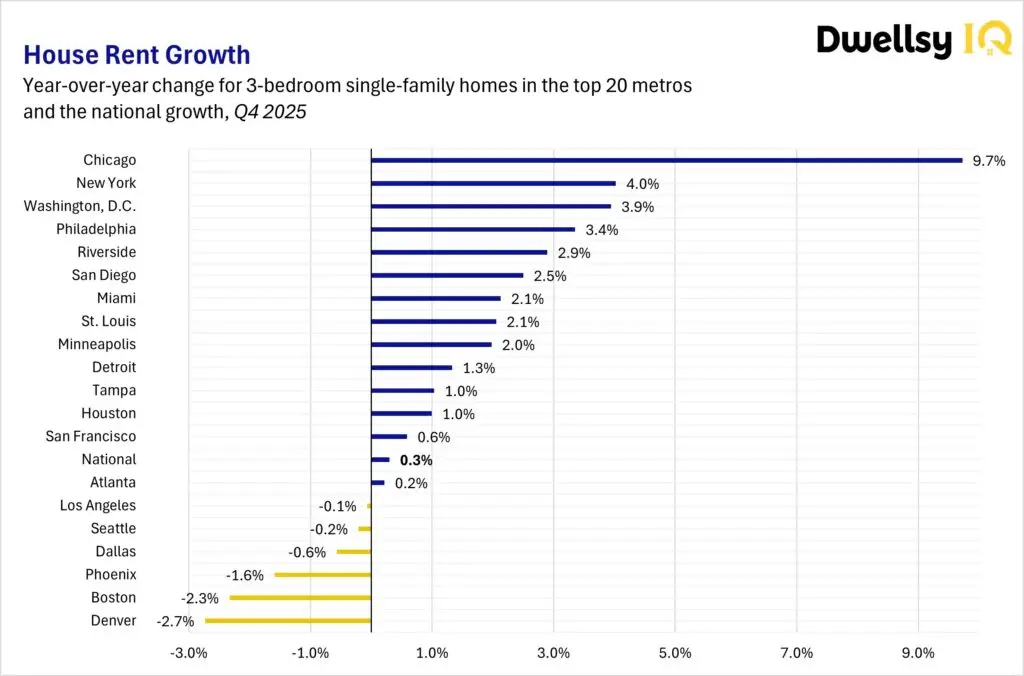
Based on year-over-year change across the top 20 metropolitan areas analyzed, only six metros recorded negative house rent growth. The markets below saw the biggest house rent declines, ordered from largest decline to smallest.
1. Denver — -2.7%
Denver recorded the steepest decline in house rents among major U.S. metropolitan areas, with rents falling by 2.7%. Average rents decreased from $2,716 to $2,642, representing the largest downward movement observed across the markets analyzed.
2. Boston — -2.3%
Boston posted one of the largest house rent declines among major metros, with rents declining by 2.3%. Average rents decreased from $3,461 to $3,381, reflecting softer rent conditions relative to stronger-performing markets.
3. Phoenix — -1.6%
Phoenix recorded a noticeable contraction in house rents compared to national trends, with rents declining by 1.6%. Average rents decreased from $2,014 to $1,982, indicating weaker local rent momentum.
4. Dallas — -0.6%
Dallas experienced a modest decline in house rents, with rents decreasing by 0.6%. Average rents moved from $2,000 to $1,989, suggesting relatively stable but slightly weakening rent conditions compared to faster-growing metros.
5. Seattle — -0.2%
Seattle saw a small decrease in house rents, with rents declining by 0.2%. Average rents decreased from $2,929 to $2,923, reflecting largely stable market conditions with limited downward pressure.
6. Los Angeles — -0.1%
Los Angeles recorded a slight decline in house rents, with rents decreasing by 0.1%. Average rents moved from $3,857 to $3,854, indicating near-flat rent movement despite broader variation across major metropolitan areas.
How much faster did these cities declined compared to the national average?
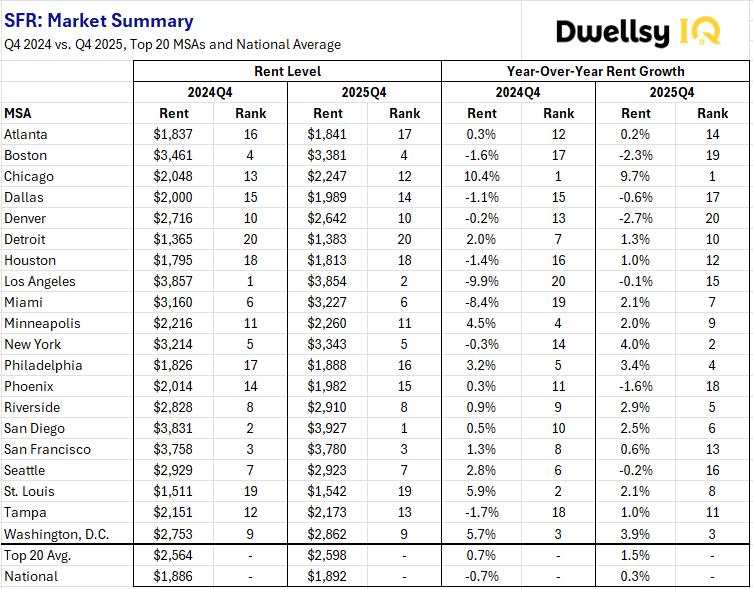
At the national level, house rents increased by 0.3%, rising from $1,886 to $1,892. While most markets remained broadly stable, the recent divergence between rising and declining metros raises an important question about how the rental market may respond in 2026.
Compared with this modest nationwide movement, a small group of metropolitan areas recorded measurable declines.
Denver stood furthest below the national trend, with house rents declining 2.7%, moving from $2,716 to $2,642 — a decline roughly nine times larger than the national increase in the opposite direction. This positioned Denver as the clearest negative outlier among major U.S. markets, with rent movement that contrasted sharply with broader national stabilization.
Boston (-2.3%) and Phoenix (-1.6%) also declined substantially relative to the national trend. Average rents fell from $3,461 to $3,381 in Boston and from $2,014 to $1,982 in Phoenix, representing declines roughly five to eight times larger than the national increase, highlighting weaker local rent momentum compared to overall U.S. conditions.
A second group of markets — including Dallas (-0.6%) — recorded smaller declines but still moved below national performance. Dallas rents decreased from $2,000 to $1,989, representing a decline roughly twice the magnitude of the national increase, indicating modest softening rather than a broad contraction.
Meanwhile, Seattle (-0.2%) and Los Angeles (-0.1%) saw only minimal downward movement. Rents declined from $2,929 to $2,923 in Seattle and from $3,857 to $3,854 in Los Angeles, reflecting largely stable conditions where rent changes remained close to flat despite broader variation across major metropolitan areas.
Download the 2026 Rental Market Report
This article covers only part of the trends observed, as analyzed in the 2026 Rental Housing Index. Download the full report, reviewing rental market performance, for complete national and metro-level analysis across U.S. apartment markets.
FAQ
Which U.S. cities have the biggest house rent declines right now?
According to the 2026 Rental Housing Index released by Dwellsy IQ, Denver recorded the largest house rent decline among major U.S. metropolitan areas, with rents decreasing by 2.7%. Other cities with notable declines included Boston, Phoenix, Dallas, Seattle, and Los Angeles, each showing varying degrees of softening relative to national trends.
Are house rents declining in the U.S.?
No. Only a limited number of major metropolitan areas recorded declines. Most markets either experienced rent increases or near-flat conditions, highlighting how local dynamics continue to drive rental outcomes rather than nationwide trends alone.
What is the average house rent in Denver?
The average house rent in Denver is $2,642, based on the most recent data available in the 2026 Rental Housing Index by Dwellsy IQ.
What is the average house rent in Boston?
The average house rent in Boston is $3,381, based on the most recent data available in the 2026 Rental Housing Index by Dwellsy IQ.
What is the average house rent in Phoenix?
The average house rent in Phoenix is $1,982, based on the most recent data available in the 2026 Rental Housing Index by Dwellsy IQ.
What is the average house rent in Dallas?
The average house rent in Dallas is $1,989, based on the most recent data available in the 2026 Rental Housing Index by Dwellsy IQ.
What is the average house rent in Seattle?
The average house rent in Seattle is $2,923, based on the most recent data available in the 2026 Rental Housing Index by Dwellsy IQ.
What is the average house rent in Los Angeles?
The average house rent in Los Angeles is $3,854, based on the most recent data available in the 2026 Rental Housing Index by Dwellsy IQ.