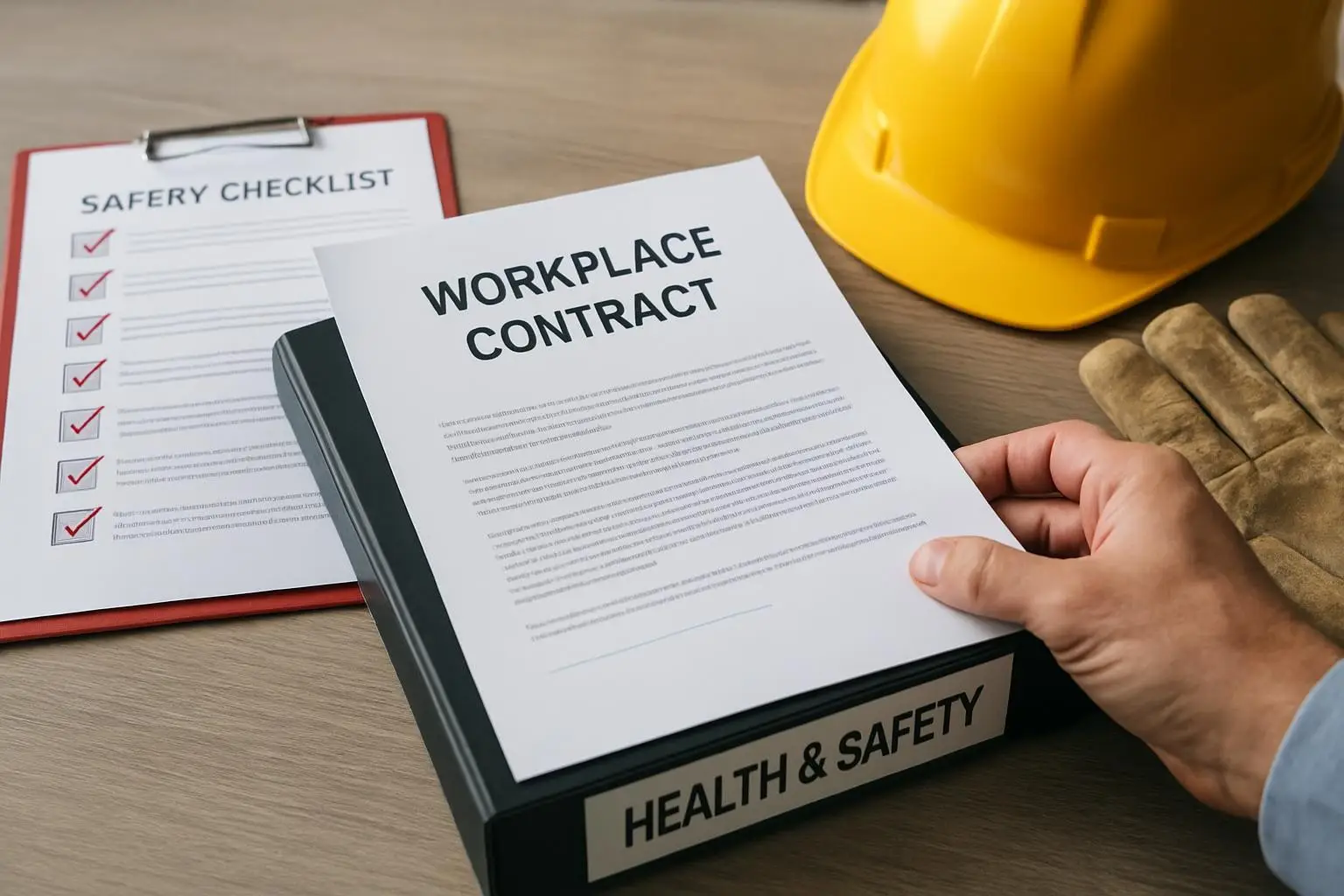
Health and safety clauses often get overlooked during contract negotiations, yet they carry real weight for anyone assessing a deal. Whether you are an investor reviewing a target company, a data-driven analyst scoring risk, or a real estate stakeholder managing contractors on-site, these clauses tell you how parties allocate responsibility for keeping people safe and staying compliant. Below, we break down what the clause does, the key terms to watch, and a ready-to-use template you can adapt.
1) What is a health & safety clause in commercial contracts—and why do investors care?
A health and safety clause is a contractual provision that defines each party’s obligations to prevent injury, illness, and hazardous conditions while performing under the agreement. It typically requires compliance with applicable laws, establishes safe working practices, and allocates responsibility if something goes wrong.
Why it matters: accident prevention, compliance posture, and risk allocation
For investors, this clause is a signal of operational discipline. A well-drafted provision shows that counterparties take compliance seriously, which reduces the chance of regulatory fines, litigation, and reputational damage.
Moreover, the clause allocates risk. If a contractor causes an on-site accident, the clause often determines who bears the cost. For real estate portfolios with active construction or maintenance, that allocation directly affects exposure.
From a data perspective, the presence and strength of these clauses can be tracked across a contract portfolio as a measurable compliance indicator.
2) What health & safety clause types show up most often?
Not all health and safety clauses look the same. They vary by purpose, scope, and how aggressively they shift responsibility.
Common forms: compliance covenants, safety representations, and responsibility allocation
First, compliance covenants commit a party to follow specific laws and standards throughout the contract term. These are forward-looking promises about future conduct.
Second, safety representations are statements of fact, usually confirming current compliance at signing. If the representation proves false, the other party may have a claim.
Third, responsibility allocation provisions assign duties and liability among parties, including indemnities that cover losses tied to safety failures. Together, these forms create a layered framework that addresses both present conditions and future obligations.
3) What should you check in a health & safety clause?
When reviewing a clause, focus on whether it covers the practical risks of the engagement rather than relying on vague language.
Must-have drafting points: applicable laws, hazard prevention, safe systems, and subcontractor flow-down
Start with applicable laws. The clause should reference the specific regulations that govern the work, not just “all applicable laws” in general.
Next, confirm hazard prevention language that addresses recognized risks, even where no formal standard exists. This closes gaps that purely standards-based wording can leave open.
Then, look for safe systems of work, which require documented procedures, training, and protective measures. Finally, check subcontractor flow-down, which ensures that safety obligations pass to any third parties performing the work.
4) Copy-ready sample health & safety clause for commercial contracts
The following template provides core wording that you can adapt to your jurisdiction and deal structure.
Core wording plus optional add-ons: incidents, audits, and cooperation
Core clause: “Each party shall, at its own cost, comply with all applicable health and safety laws, regulations, and recognized standards relevant to its performance under this Agreement. Each party shall implement safe systems of work, identify and mitigate foreseeable hazards, and ensure that its personnel and subcontractors are suitably trained and supervised.”
Optional – incident reporting: “A party shall notify the other party in writing within [24/48] hours of any accident, injury, or dangerous occurrence arising from the performance of this Agreement, and shall provide a written incident report within [number] days.”
Optional – audit rights: “On reasonable notice, a party may audit the other party’s health and safety records, policies, and practices relevant to this Agreement.”
Optional – cooperation: “The parties shall cooperate in good faith on health and safety matters, including coordinating activities where personnel share a common workspace.”
5) How does a health & safety clause affect risk, liability, and contract outcomes?
The clause shapes outcomes well before any dispute arises. Clear duties reduce ambiguity about who must do what.
Practical impact: clearer duties, proof of due diligence, and reduced dispute risk
First, defined obligations give each party a reference point for performance. When duties are explicit, disagreements narrow to facts rather than interpretation.
Second, compliance records, audits, and incident reports serve as evidence of due diligence. That documentation can support a defense if regulators or claimants raise questions.
Third, because responsibility is allocated in advance, parties are less likely to litigate over who bears a loss. As a result, the clause can lower both dispute frequency and resolution costs.
6) How should deal teams customize a health & safety clause?
A template is a starting point, not a finished product. Deal teams should tailor the wording to the specific transaction and setting.
Scope, governing law alignment, timelines, remedies, and measurable obligations
Begin by defining scope, so the clause matches the actual work, site, and risk profile. Then align the wording with the governing law named elsewhere in the contract to avoid conflicting references.
Next, set clear timelines for reporting and remediation, and specify remedies such as cure periods, indemnities, or termination rights. Finally, favor measurable obligations, such as defined reporting windows and documented training, which are easier to enforce than general commitments.
FAQs
What should you look for when reviewing a health & safety clause in a deal?
Look for specific legal references, hazard prevention language, defined safe systems of work, subcontractor flow-down, and clear remedies. In addition, check that reporting and audit rights are drafted with concrete timelines.
Who typically owns health & safety obligations, including subcontractors?
Each performing party generally owns obligations for its own personnel and activities. Through flow-down provisions, the primary contractor usually remains responsible for ensuring subcontractors meet the same standards.
Does a health & safety clause cover recognized hazards even without a specific standard?
It can, provided the wording includes a general duty to identify and mitigate foreseeable or recognized hazards. Without that language, the clause may only cover risks tied to named standards.
What’s the difference between a compliance covenant and a safety representation?
A compliance covenant is a promise about ongoing future conduct. A safety representation is a statement of fact about current conditions at a specific point, usually at signing.
Can incident reporting and audit rights be drafted as enforceable requirements?
Yes. When drafted with defined timelines, formats, and access terms, these provisions become enforceable obligations rather than optional practices.
How does a health & safety clause affect claims, costs, and dispute risk?
By allocating responsibility in advance and documenting compliance, the clause narrows the scope of disputes. Consequently, it can reduce the frequency of claims and the cost of resolving them.
Is a health & safety clause enforceable as written across jurisdictions?
Enforceability varies by jurisdiction, because local laws may impose mandatory duties that override contract terms. For that reason, align the clause with the governing law and confirm local requirements before relying on it.
Appendix: Quick reference wording for common health & safety drafting points
Compliance: “Each party shall comply with all applicable health and safety laws and recognized standards relevant to its performance.”
Hazard prevention: “Each party shall identify and mitigate foreseeable hazards arising from its activities under this Agreement.”
Safe systems of work: “Each party shall implement documented procedures, training, and protective measures for its personnel.”
Subcontractor flow-down: “Each party shall ensure that its subcontractors are bound by health and safety obligations equivalent to those set out in this Agreement.”
Incident reporting: “A party shall report any accident or dangerous occurrence within [24/48] hours and provide a written report within [number] days.”
Audit rights: “A party may, on reasonable notice, audit the other party’s relevant health and safety records and practices.”
Remedies: “Failure to comply may trigger cure rights, indemnification, or termination as set out in this Agreement.”